
Can 3D Printed Nylon Replace Injection-Moulded Parts?


A 3D printed nylon part genuinely can take the place of an injection-moulded part at the small-batch stage, but not in every case. The deciding factor is not the quantity — it is how the part is loaded and how it has to look. Below we go through the differences between the two processes, where the boundary of substitution sits, and how to judge it.
1. The short answer
For small quantities, complex geometry and parts where tooling does not pay for itself, making the part directly in SLS or MJF is a well-established approach. But where the part carries a long-term load, needs a high-quality appearance, or is already running at high volume, injection moulding is still the better fit. In one line: printing wins on “no tooling and free design changes”, and loses on “unit cost and consistency ceilings”.
2. Where the two processes actually differ
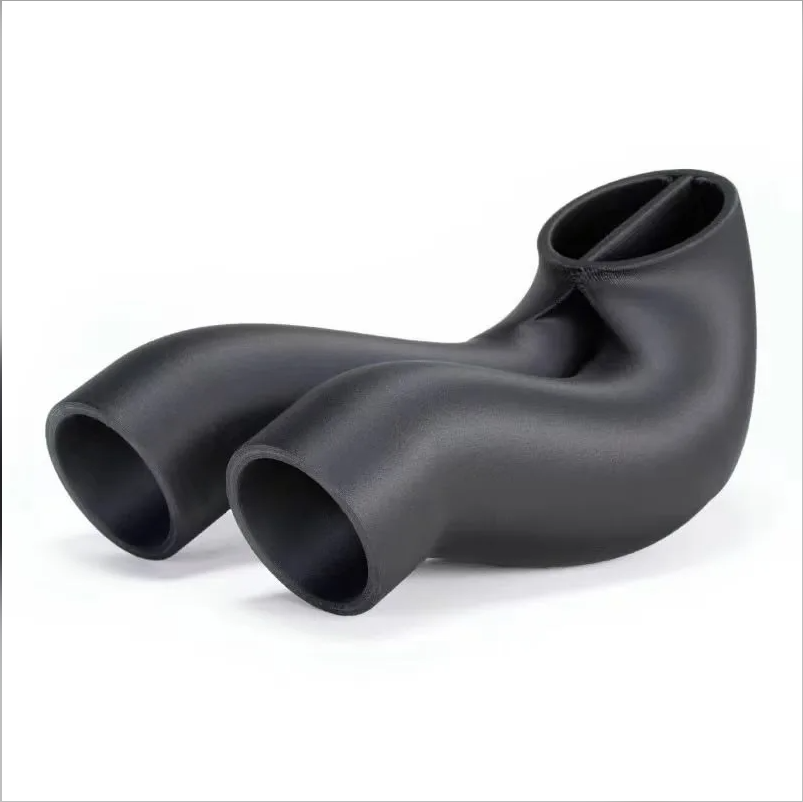
- Forming method — moulding injects molten material into a tool, giving dense material and consistent batches; SLS / MJF build parts layer by layer in a powder bed, where interlayer bonding and porosity set the performance ceiling.
- Material range — moulding offers a wide range of nylon grades, including glass-fibre and carbon-fibre filled options; 3D printing also covers PA12, PA11 and reinforced grades, but the menu is narrower.
- Cost structure — moulding spreads tooling cost across the run, so unit price falls as volume rises; printing has no tooling cost, but unit price is hard to reduce beyond a point.
- Lead time — printing needs no tool, so parts come out in days; tooling usually takes weeks.
- Design changes — a moulding change may mean re-cutting the tool, while printing just needs a re-exported file.
The differences come down to two things: the one-off tooling cost, and part-to-part consistency. Get those two clear and the substitution decision has a basis.
3. Four checks on whether printing can replace moulding
- Quantity — tens to a few hundred parts, before tooling becomes economic, can start on printing.
- Loading — if the part mainly sees assembly force and drop impact, nylon is usually sufficient; sustained cyclic loading needs care.
- Appearance — if a matte surface with fine layer lines and support marks is acceptable, there is no problem.
- Accuracy — tolerances inside the process capability are fine; precision mating faces may still need CNC finishing.
The one most often overlooked is sustained cyclic loading. Assembly force and drop impact, whether once or repeated, are generally manageable in nylon; but structures that flex repeatedly or carry load continuously find interlayer bonding to be the weak point, and those parts are better moulded.
4. What performance printed parts actually reach
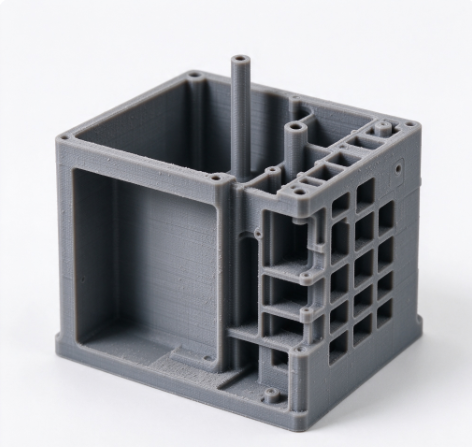
Many people worry that printed parts feel like plastic or cannot carry load, yet today’s printed nylon performs at a respectable level. Taking the grades Primofort keeps in stock as an example:
- Nylon 12 — around 50 MPa tensile strength and 1.7 GPa tensile modulus, in the same bracket as some moulded nylons.
- Glass-fibre reinforced Nylon 12 GF — around 4.1 GPa flexural modulus with a 162 °C heat deflection temperature at 1.8 MPa, enough for structural brackets.
- Carbon-fibre reinforced grades — tensile modulus above 5 GPa in the X direction, used for replacing metal parts.
- Our own YC120CF nylon carbon fibre — 50.6 MPa tensile strength and 64 MPa flexural strength, with third-party test data available.
In other words, apart from long-term fatigue and mirror-finish appearance, most structural parts can have their performance requirements met in printed nylon.
5. Primofort’s powder-bed nylon capability
Primofort runs its own powder-bed production line, with SLS on a Formlabs Fuse 1+ alongside an HP Jet Fusion for MJF. From the same drawing, the route is confirmed with the customer against requirements, budget and service environment rather than pushed one way by default — orders that specify Jet Fusion come mostly from overseas customers. Standard prototypes take 1–2 days and small-to-mid batches 3–5 days; when a part then needs CNC finishing, surface treatment or silicone vacuum casting, it can all be done under the same roof instead of passing files around.
6. When printing is not the right substitute
- Volume has already reached several thousand parts, where amortised tooling makes moulding cheaper.
- The part has to carry sustained cyclic loading, or has a defined fatigue life.
- The appearance requirement is mirror finish, high gloss or seamless — moulding, or additional finishing, fits better.
- Batch consistency has to be extremely tight (medical parts or precision transmissions, for example) — moulding’s stability is the advantage there.
Conclusion
If you have a moulded part in mind that you would like to replace, send the drawing (STL, STEP or IGS are all fine) together with the estimated annual volume, and Primofort will give a first view on whether substitution is viable before discussing process and price. A note on the service environment and the loads involved makes that assessment more accurate.